Learning Experience/Unit
Navigating the Periodic Table by St. Lawrence-Lewis BOCES
Course, Subject
Chemistry, Math, Science & Technology
Grade Levels
Commencement, 9th Grade, 10th Grade, 11th Grade
Assessment
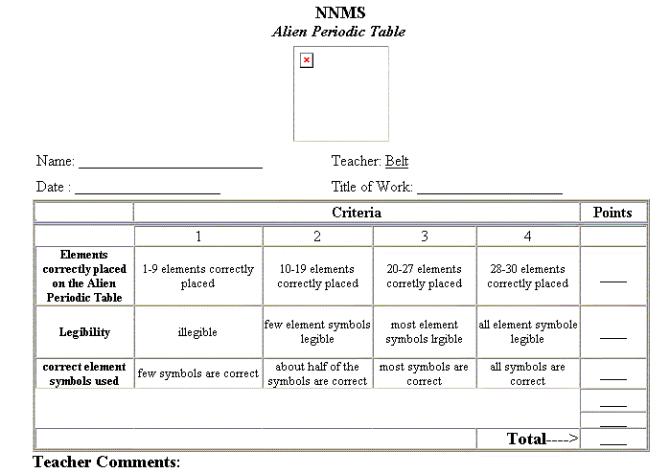
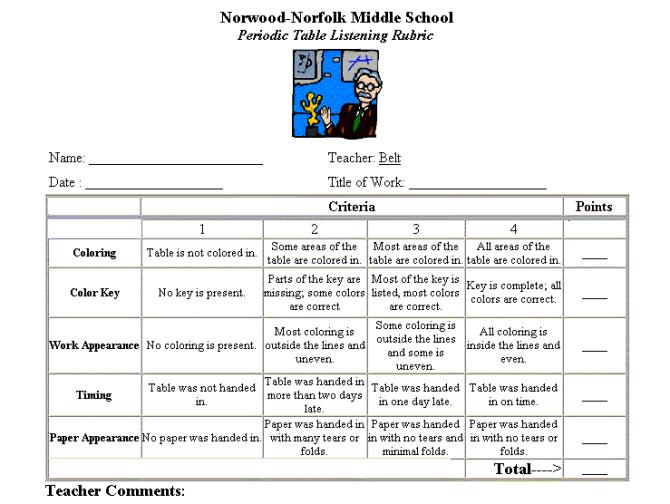
Grading rubric will be used to assess the student created periodic table.
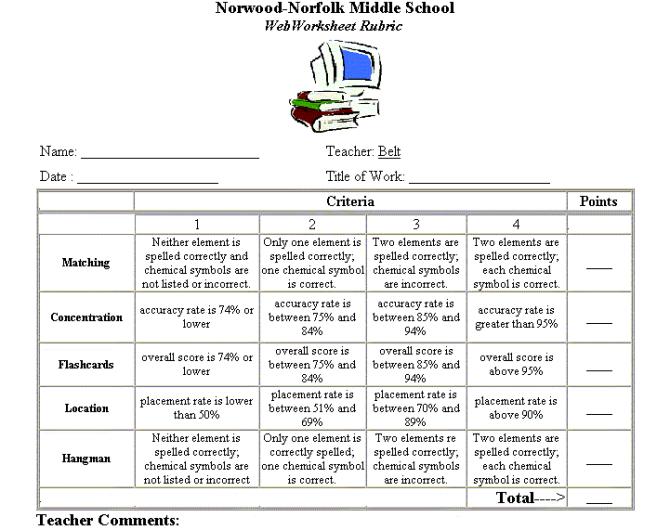
Grading rubric will be used to assess student web sheets.
Written test will be administered.
See attached.
Learning Context/ Introduction
In this unit, students will be introduced to the layout of the Periodic Table. They will locate groups and families, describe characteristics and properties of metals, non metals and metalloids and associate bonding with placement on the table.
Duration
seven 40-minute periods
Essential Question
How do properties of elements determine their placement on the Periodic Table?
Instructional/Environment Modifications
Computer to run PowerPoint in a regular classroom
Computer Lab for student use
CPS Unit (eInstruction's Classroom Performance System)
Testing accommodations for identified students
Procedure
Day One.
- Using Periodic Table PowerPoint review the following information: atomic number, chemical symbol, chemical name, atomic mass unit, number of protons, neutrons, and electrons.
- Give each student a white copy of the Periodic Table
- As students view the PowerPoint, they will color in the location of the following groups: Alkali Metals, Alkaline Earth Metals, Transition Elements, Lanthanides and Actinides, Noble Gases, Halogens, Metalloids, and Hydrogen. Students will use different colors to create the following a key: Alkali Metals - blue, Alkaline Earth Metals - red, Transition Metals - brown, Lantnanides and Actinides - orange, Noble Gases - purple, Halogens - green, Metalloids - yellow.
- Students will keep colored Periodic Tables in binders for future reference.
Day Two.
- Using index cards and markers, students will make flashcards of significant elements symbols, atomic numbers, and group locations.
- Students will play "Around The World" with element symbol flashcards as they become familiar with significant elements. (Teacher holds flashcards for a pair of students standing by their chairs to look at. The first one to say the correct element moves on to the next challenger while the other student sits down. Play continues around the room until a student has made it back to their seat).
Day Three.
- Review the importance of valance electrons in chemical bonding by viewing The Octet Rule & Atomic Bonding segment from Standard Deviants School Chemistry: Inside the Atom. Download from powermediaplus.com
- Review properties of metals, nonmetals and metalloids.
- Discuss element location on the Periodic Table and its reference to bond strength and type.
- Students will play IUPAC Game (variation of UNO) .
- While playing students will be reviewing chemical symbols and element locations on the Periodic Table.
Day Four.
- Students will play "Name That Element" using the CPS.
- Students will read clues on the screen and identify the element by keying in their answer
Day Five.
- Students will use the Computer Lab to complete the Periodic Table Web Worksheet on their own.
- The teacher will assist students with specific questions individually.
Day Six.
- Students will complete the Alien Periodic Table activity with a partner. This project will be used as an assessment for the previous lessons.
Day Seven.
- Students will complete a written test. This will be used as an assessment for the unit.
Periodic Table TemplateWeb WorksheetAlien Periodic Table ProjectPeriodic Table PowerPointPeriodic Table Quiz
Reflections and Feedback
This unit was intriguing to students. They enjoyed coloring as a method of learning placement on the Periodic Table. At this level, games seem to be few and far between so the flashcards, websheet and "UNO" type game were welcome variations to daily lessons. I feel the time invested in the lessons were worthwhile since these lessons provided basic knowledge that will be used throughout the year. Students could have been asked to print out their pages from the websites rather than simply fill in the websheet.
Student Work
Students will create their own color-coded periodic table from template.
Students will complete Periodic Table Websheets.
Students will complete written test.
Students will interpret information to create an Alien Periodic Table.
See attached student work samples.
Sample ASample BSample C
Related Resource
EBSCO * Name That Element Series
Prentice Hall Science Explorer Series * Chemical Building Blocks ISBN 0-13-429200-6
IUPAC Game purchased from ScienceKit (played similar to Crazy Eights where students play cards based on region, period or family. This game can be purchased from ScienceKit or homemade).