Learning Experience/Unit
Tezen: A Haitian Folktale
Subject
English Language Arts (2005)
Grade Levels
Intermediate, 6th Grade
Learning Context/ Introduction
The Haitian folktale, Tezen (Teen), is about a young
girl’s friendship with a fish. The fish allows her to
get cool, clear, sweet water from the spring. The
girl’s father becomes aware of this special friendship,
is upset by it, and decides to end it. The story
focuses on this friendly, pure relationship, which
rendered the girl’s father concerned and her brother
jealous. The girl is eventually driven away from her
family into the fins of her friend, Tezen, who also
happens to be king of the waters. This is an excellent
story for adolescent children whose parents are
uncomfortable with a new culture and environment,
and are prevented from interacting socially with others
as a result of their own prejudices.
Metaphorically, the ending of this story tells how we
sometimes lose those we love and overprotect.
The learning experience brought about a great sense
of pride in these sixth-grade Haitian Creole-speaking
students whose native language proficiency
spanned a wide range of abilities (the group included
students with a special education classification).
After the story was read in class, the students had to
do research by asking family members about the
folktale. The students used their native language to
learn about literary devices such as metaphor and
simile, as well as to discuss the concepts of prejudice
and cultural differences and similarities in our world.
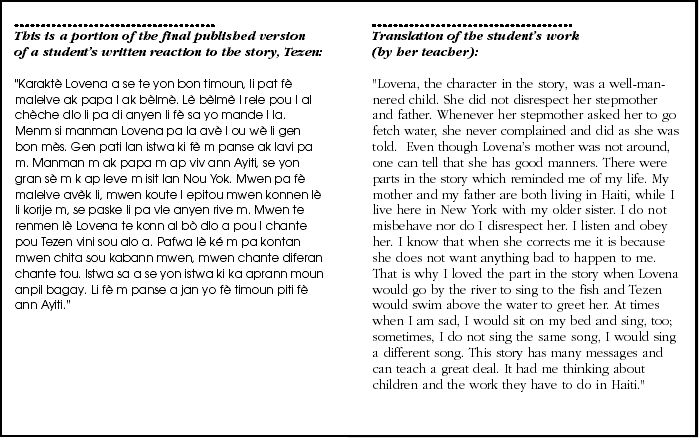
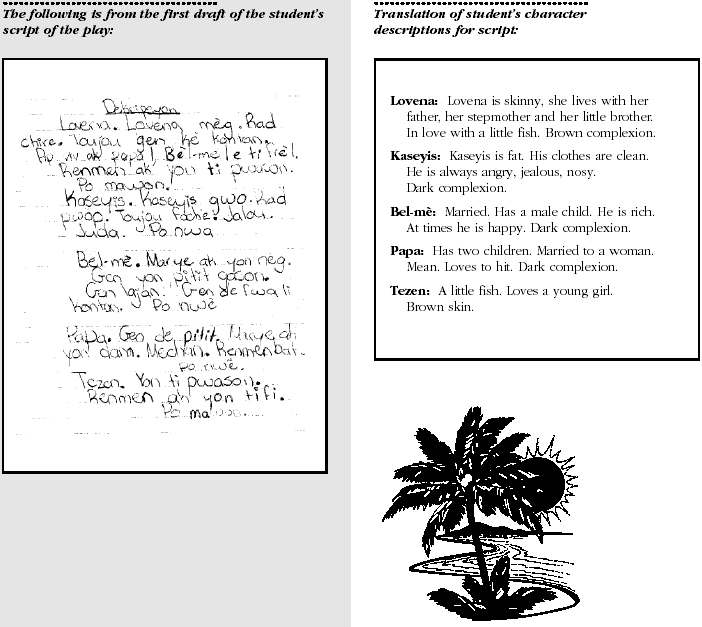
Student Work
Procedure
Teacher Activities
- The teacher initiated a discussion about friendship, and then, together with the students, made a concept map.
- The teacher used prompts from the story to stimulate predictions from the students.
- The teacher read the story aloud to the class.
- The teacher discussed the story with the students, using multi-level questioning involving inference, opinion, and analysis.
- The teacher elicited discussion about the relationships among the members of the girl's family.
- The teacher generated a discussion of how language, cultural awareness, and cultural relevance affect the story.
- The teacher helped the students to summarize what they learned from the story.
- The teacher selected a group of vocabulary words for the students to use in their written reactions.
- The teacher assigned a writing task in which the students were asked to provide a review or personal reaction to the story, using the new vocabulary.
- The teacher created small groups of six students to work on writing a script that they would act out.
- The teacher guided and facilitated the development of the scripts through the students' writing process.
- The teacher videotaped the performances.
Student Activities
- The students brainstormed with the teacher the many forms of friendship.
- The students made predictions about the story using their experiences and prior knowledge.
- The students listened to the story and responded to the teacher's questions.
- The students participated in a discussion of family relationships and cultural traits and patterns.
- The students discussed important linguistic and cultural variations among groups who share the same language.
- The students wrote a personal response or review of the story incorporating the new vocabulary learned.
- The students worked in groups of six to create a script of a dramatic performance based on the text of the story and on related personal experiences.
- The students incorporated stage directions in their scripts and music and props in their performances.
- The students subsequently revised their work in order to clarify it or make it more effective in communicating the message or thought.
- The students performed their plays, using appropriate body language, speech, and intonation to deliver their lines.
- The students assisted in videotaping their performances.
Instructional/Environment Modifications
- Students were grouped to complement their abilities.
- They had visual aids such as cue cards; recordings of music and other props were also made available.
- Recording equipment was used to facilitate review of student work as it was discussed.
- Environmental modifications were made as needed for the performances.
Materials and Supplies
- Tape recorder
- TV and VCR
- Camcorder
- Blank audio-cassettes/videocassettes
- Scanner
- Notebooks, pencils, etc.
- Computer
- Poster board
- Other supplies as needed for the project presentation
- Books:
- Tezen, by Mimi Barthelm
- The Magic Orange Tree: and Other Haitian Folktales, by Dianne Wolkstein
- Bouki Dances Kokiyoko, by Dianne Wolkstein
For more information on Tezen, click here
For more information on The Magic Orange Tree, click here
For more information on Bouki Dances Kokiyoko, click here
Assessment Tools and Techniques
The teacher assessed the work of the students on an ongoing basis throughout the learning experience on a number of dimensions:
- direct observation of the students;
- review of students' work;
- fluency in reading, participation in group discussions, and conferencing with students; and
- ability to transform the story into a script for performance.
Time Required
- Planning: Eight to fifteen hours
- Implementation: Six to eight weeks
- Assessment: Ongoing throughout implementation of the learning experience
Student Work
Selected Examples:
Reflection
"The students were elated and totally
committed to this project. They became
more knowledgeable about the Haitian
culture as they interacted with family
members, who sought the opportunity to
tell more stories and to engage them in
the morality embedded in our stories. The
link that the story brought between family
members was priceless. The students’ play
was also spectacular. Throughout the
process their growth in writing, character
analysis, vocabulary and script writing
was continuous and evident. The students
discovered their talents as actors, artists
and playwrights. They beamed with
pride."
Author
Marie Jose Bernard, Haitian Creole Bilingual Teacher
Community School District 17, P.S. 22
Brooklyn, NY.
Source
Bernard, Marie Jose. "A Haitian Folktale." The Teaching of Language Arts to Limited English Proficient/English Language Learners: Learning Standards for English as a Second Language. New York State Education Department, 73-76.